

Unlocking Cross-Atlantic Petroleum Systems: Oil Families and New Insights from Côte d’Ivoire
Understanding oil families is no longer just an academic exercise in geochemistry. When applied at a regional and global scale, it becomes a powerful tool for predicting fluid properties, de-risking exploration, and unlocking overlooked connectivity across basins.
GeoMark’s regional studies across the Equatorial and South Atlantic margins continue to reinforce a key idea: petroleum systems do not respect modern basin boundaries. Instead, they reflect shared depositional histories, migration pathways, and source rock evolution that extend across conjugate margins.
This is particularly evident offshore Côte d’Ivoire.
A System Defined by Oil Families, Not Geography
Through integrated biomarker, isotopic, and advanced analytical workflows, oils offshore Côte d’Ivoire can be grouped into four primary oil families:
ICM1, ICM2, ICM3 – Cretaceous marine (ACT) sourced systems
ICT4 – younger Paleogene paralic marine system
Each reflects a distinct source rock, maturity profile, and migration history, reinforcing that even within a single margin, multiple petroleum systems can coexist and interact.
ICM1: A Cross-Atlantic Oil Family
One of the most compelling examples is the ICM1 oil family.
ICM1 oils, identified offshore Côte d’Ivoire in fields such as Espoir and Ivco, are interpreted to be sourced from Cenomanian–Turonian (OAE2) marine shales and are typically reservoired in shallower Upper Cretaceous sands.
What makes ICM1 particularly powerful is its geochemical continuity across continents:
Correlates with oils and seeps in Guyana and Suriname
Extends into Brazil’s Equatorial Margin (Para-Maranhão Basin)
Represents a shared distal marine ACT source system
This correlation is grounded in consistent:
Sterane and terpane biomarker distributions
Carbon isotope signatures
Advanced GC-MS/MS (QQQ) datasetsOil families don’t stop at basin boundaries.
The below map shows how GeoMark’s geochemical and statistical analysis connects South Atlantic petroleum systems across Africa and South America—revealing true conjugate margin continuity.

Together, these confirm a linked petroleum system developed during Atlantic opening, rather than isolated basin-scale charge events.
The Broader Côte d’Ivoire System: More Than One Story
While ICM1 provides the clearest cross-Atlantic link, the broader oil family framework highlights additional complexity:
ICM2 (Lion Field) Likely sourced from Albian (OAE1) marine shales, with evidence of a minor lacustrine contribution. These oils show a wider maturity spread, with higher VREQ values and diamondoid concentrations that align with deeper, more evolved charge systems.
ICM3 A lower maturity ACT-derived family that geochemically trends closer to ICM2 than ICM1, suggesting shared source inputs but differing charge timing or migration pathways.
ICT4 (Gazelle Field) A distinct system sourced from Paleogene paralic marine shales, characterized by different biomarker signatures (e.g., higher oleanane influence), representing a younger and separate petroleum system.

Taken together, these families demonstrate that Côte d’Ivoire is not governed by a single petroleum system, but by stacked and interacting charge systems across time.
Beyond Source: What Maturity Signals Reveal
While oil family classification defines where fluids come from, the real insight comes from understanding how those fluids evolved and charged the reservoir.
This is where the distinction between VREB and VREQ becomes critical.
VREB (Vitrinite Reflectance Equivalent from biomarkers) reflects early expulsion, when oils are richer in heavier biomarker compounds
VREQ (alkyl aromatic-based maturity) captures later-stage generation and migration at higher maturity
In Côte d’Ivoire, particularly within the ICM1 system:
VREB values are relatively modest (~0.70%)
VREQ values increase (~0.80–0.85%)
Diamondoid concentrations exceed VREQ expectations
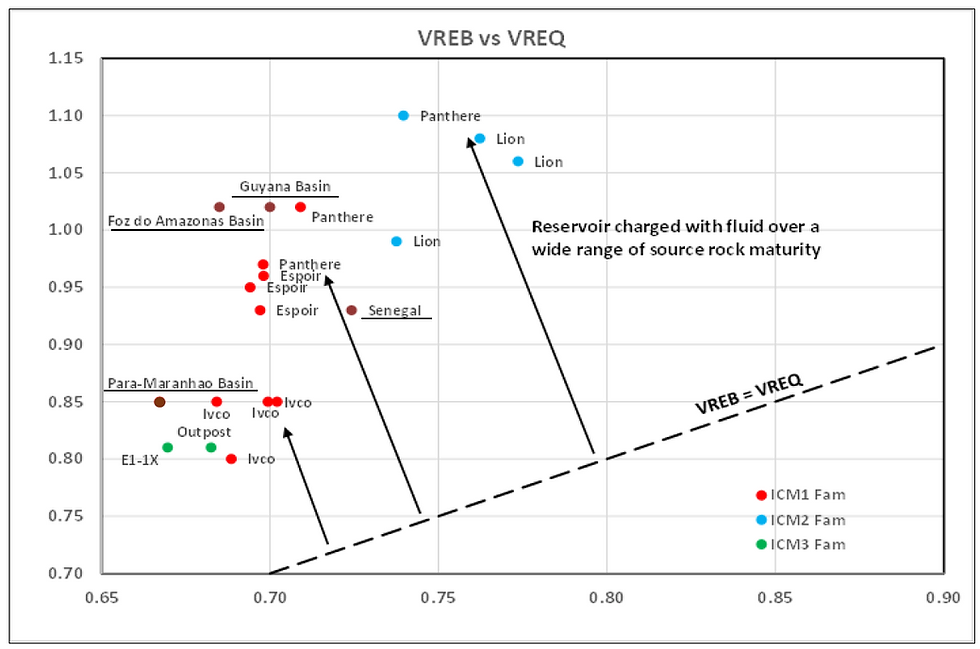

This indicates:
Contribution from deeper, gas-window sources
Mixing of multiple charge phases
Increased likelihood of elevated GORs and gas-rich systems
Migration, Mixing, and Reservoir Charge
Across the Equatorial Margin dataset, the relationship between VREB and VREQ provides a direct lens into charge history:
Small VREB–VREQ differences → rapid, single-phase charge
Large differences → prolonged charge, multiple migration events
In systems such as ICM2 and parts of ICM1, larger maturity spreads and elevated diamondoids suggest:
Long-lived migration pathways
Stacked charge events from different depths
Greater probability of fluid variability within the same reservoir
This helps explain why fluids across Côte d’Ivoire and analogous basins can vary significantly, even within the same stratigraphic interval.
Why This Matters
For operators, explorers, and asset teams, these insights translate directly into value:
Improved fluid prediction prior to drilling
Better understanding of GOR variability and phase behavior
Identification of connected petroleum systems across blocks and basins
Ability to leverage conjugate margin analogues for exploration
Most importantly, it shifts the mindset from isolated field evaluation to petroleum system-scale thinking.
Final Thought
The Côte d’Ivoire margin represents a multi-system petroleum province, where:
ICM1 connects directly across the Atlantic
ICM2 and ICM3 reflect deeper and more complex charge histories
ICT4 introduces a younger, distinct system
When integrated, these families reveal a dynamic system defined by migration, mixing, and multi-phase charge, rather than simple static accumulation.
With the application of advanced geochemical tools such as UHRGC and QQQ, alongside maturity frameworks like VREB vs. VREQ, we are moving toward a more complete understanding of subsurface fluid systems.
And in doing so, identifying opportunities that extend far beyond individual fields or basins.
A Collaborative Opportunity Across the Margin
While these insights provide a robust framework for understanding the petroleum systems of Côte d’Ivoire and the wider Equatorial Atlantic, they are by no means the final word.
Every new sample has the potential to refine, challenge, or expand the current interpretation.
At GeoMark, we continue to actively grow and enhance this regional dataset, integrating new oils, gases, PVT and source rock data into a consistent, quality-controlled framework.
By doing so, we are able to further resolve oil family relationships, improve maturity calibration, and better define migration pathways across both sides of the Atlantic.
We welcome the opportunity to collaborate with operators who are interested in:
Integrating their oil, gas, or source rock samples into this regional interpretation
Benchmarking their fluids against established oil families such as ICM1, ICM2, ICM3, and ICT4
Gaining deeper insight into charge history, connectivity, and fluid evolution within their assets
This is not limited to Côte d’Ivoire. The same framework extends across Ghana, Liberia, Sierra Leone, Guyana, Suriname, and Brazil, where shared petroleum systems continue to emerge through integrated geochemistry.
If you are looking to better understand how your fluids fit within the broader regional system, or to unlock additional value from existing data, reach out to info@geomarkresearch.com


I love how My Perfect Hotel blends light strategy with calm gameplay.
I never expected to enjoy Ragdoll Hit this much, but it's incredibly fun.
Tiny fishing hits a perfect sweet spot where it requires just enough attention to be engaging but not enough to be tiring.