
Mud Gas Case Studies
In unconventional plays, understanding working pressure, the operating pressure range that defines producibility and phase behavior is key to optimizing well placement, completion design, and production forecasting. Yet direct pressure measurements are sparse, and traditional PVT data often doesn’t extend across the full range of maturity or fluid variability present in shale plays.
To address this gap, we integrated its Mud Gas Isotope Analysis with an extensive PVT and Geochemical Database to build a more complete picture of working pressures across major basins.
Our method combined:
-
Mud Gas Isotopes (δ¹³C of C₁–C₅): to assess thermal maturity, source facies, and mixing events.
-
Compositional PVT Analysis: to define phase envelopes, bubble point and dew point pressures, and evolving fluid types.
-
Reservoir Pressure Estimates: sourced from well tests, PVT reports, and proprietary interpretations.
-
Geochemical Inputs: including TOC, Ro, and biodegradation levels to tie fluid evolution to source rock context.

Thermal Maturity Drives Fluid Type
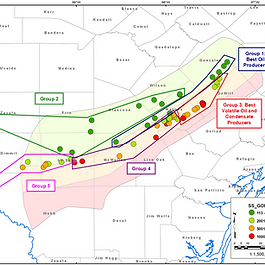
Increasing maturity derived from isotope data mapped clearly to fluid transitions from black oil to condensate to wet gas. For example, in the Eagle Ford, δ¹³C values and GOR changes aligned with shifts in Psat (saturation pressure), confirming gas evolution below bubble point was driving increased GOR in low-pressure zones.

Mud Gas Isotopes Validate and Expand PVT Coverage
In the absence of full lab analysis, mud gas isotope profiles offer reliable estimates of maturity that correlate with GOR, Psat, and phase type across the basin.

GOR Maps with Isotopic Overlays
GeoMark generartes regional maps (e.g., Eagle Ford, Utica, Gulf of America) showing GOR vs. reservoir pressure with pverlaid isotope derived maturity, revealing key boundaris between productive and non-productive zones.
Saturation Pressure Trends by Basin
Using mud gas and PVT data, we built curve showing GOR vs. Psat for major plays, helping clients identify areas where pressure has dropped below the bubble or dew point, critical for forecasting production declines and designing artificial life.